
Fall Foliage Forecast for New England 2026
It’s time for my 2026 New England Fall Foliage Forecast. We “ONLY” have 190 days till the First day of autumn in September. I don’t think we’ll see really strong color that early, but we should see peak breaking out by the 1st of Oct in places like Groton State Park in Vermont and North of the White Mtns, but more on that later…
While New England is currently under a receding blanket of winter snow, my mind is already wandering to the crisp air of October 2026. The puzzle pieces for this year’s autumn show are already moving—from shifting Pacific temperatures to the deep moisture currently soaking our soil. If you’re ready to start dreaming of fiery maples and winding backroads, you’re in the right place. This is my first long-range look at why 2026 could be shaping up to be a ‘Late but Great‘ classic.
The first day of Spring is just days away, and I’ve been looking over different forecasts. I’m going to try to give you my take on what I “think” will happen.
You can read these three over and see what you think. Let me know in the comments if you agree or disagree. My “opinion” will follow at the bottom.
Severe Weather Europe (SWE)
The Severe Weather Europe website is usually a good source, and for 2026, they are a bit more positive in their outlook. They are talking about a “Super El Niño,” which is based on their assumption that the water temperatures in the Pacific will rise above the average El Niño temps of 0.5 °C to 1.5 °C, and if it breaks 2.0 °C, then it will apparently become a Super El Niño.
Spring 2026: The Transition
Active Cold Corridor: While the western US warms up early, the Northeast is expected to remain in a “cold corridor.” Forecasts indicate a low-pressure area over southeastern Canada and the Northeast, which may lead to below-normal spring temperatures and a late start to the warm season.
Summer 2026: Mild but Humid
The Temperature “Shield”: Unlike the Pacific Northwest and South, which are braced for extreme heat, the Northeast may see near-normal or slightly below-normal summer temperatures. This is due to a projected low-pressure system over eastern Canada that favors a cooler northerly flow.
Hurricane Protection: The emerging El Niño acts as a “natural shield” by increasing wind shear in the Atlantic. This is expected to result in suppressed hurricane activity and a lower risk of major landfalls along the Eastern Seaboard.
NOAA Climate Prediction
The SWE bases its forecast on the NOAA Forecast, but it comes down to the interpretation of the data. The report from NOAA is much more negative (or realistic).
For 2026, the climate outlook indicates a significant shift from the current La Niña conditions to a likely El Niño by late summer. For the Northeast, this transition typically brings warmer temperatures and a persistent risk of drought in the short term, though the developing El Niño could eventually shift the pattern toward wetter conditions by winter.
Summer and Autumn 2026: Heat and Drought Risk
Heatwaves: Current forecasts for June-July-August (JJA) and July-August-September (JAS) show an increased probability of above-normal temperatures for the Northeast. This is driven by a combination of long-term climate trends and the emerging El Niño, which often suppresses the Atlantic hurricane season but can favor ridging patterns that lead to stagnant, hot air masses in the East.
Drought Potential: As of March 2026, long-term drought persists in parts of the Northeast, including New England and the Mid-Atlantic. The Seasonal Drought Outlook indicates that while recent rains provided some relief, drought is favored to persist or even expand in the Northeast through late spring and early summer due to a lack of a strong “wet signal” and typical seasonal soil moisture depletion.
Old Farmer’s Almanac (OFA)
The OFA has been predicting the weather for as long as I can remember (I looked it up, over 230 years is when they started), and to be honest, I don’t know what magical recipe they create it with.
Be sure to visit my Beginning Your Fall Foliage Journey. This will get you started on some of my best articles to help you plan your journey.
12-Month Long-Range Weather Outlook
November 2025 to October 2026: Winter temperatures will be above normal, with the coldest periods in December and early January. Precipitation and snowfall will be below normal, with the snowiest periods in mid-November, early and mid-December, and early February. April and May will be warmer and drier than normal. Summer temperatures will be above normal, while rainfall will be above normal in the north and below normal in the south. The hottest periods will be in early June and early and late July. September and October will be cooler and wetter than normal.
Jeff’s 2026 New England Fall Foliage Forecast
I’m looking at the “hard winter” of 2025/26 as my basis; I think the most likely outcome for this autumn is a possibly High-Color Season. While the early summer may begin with the heat and drought risks mentioned as a possibility by NOAA.
The record-breaking moisture we get from our winter snowpack might act as a critical “drought-shield,” keeping the trees resilient during those hot July spells per the SWE. I think we may see more rainfall than in 2025.
The Old Farmer’s Almanac—which was pretty close last year, predicts that this year may bridge the gap between the other two scenarios. Their 2026 forecast calls for a hotter-than-normal summer followed by a September and October that turns cooler and wetter than average. This aligns perfectly with the transition into the Super El Niño of the SWE, which typically suppresses hurricane activity but favors a more active, moisture-rich coastal track by mid-autumn.
The Result? We are likely looking at a “slightly Later but Great” season. The deep winter moisture “should” ensure that we have a healthy canopy, while the Almanac’s predicted “cool snap” in September should/could provide the thermal trigger for brilliant colors. While we expect fewer named tropical storms due to the El Niño “effect,” the real race as always with a “slowburn” season will be against any New England storms in October.
Where will you find early areas of high to peak color?
- Last week in September – NW Maine around Flagstaff Lake
- First week in October – Groton State Park, Vermont, and Northern White Mountains (higher elevations)
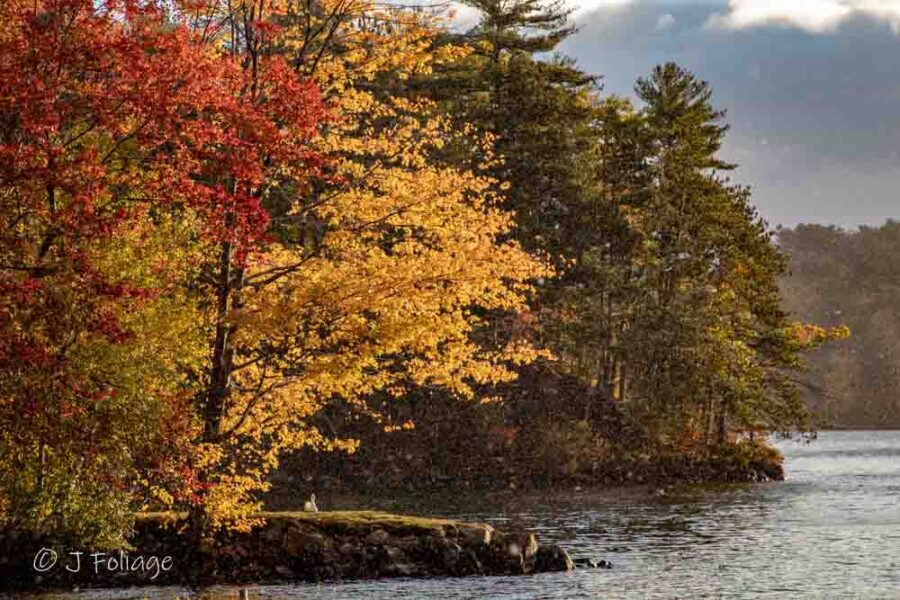
I “THINK” we can plan for a vibrant peak season that arrives slightly later than usual, but “could” pack a serious punch
—As long as the weather is gentle!
— As long as the drought is minimal!
— As long as Mother Nature behaves! excetera, excetera…
Or anything else that rips my forecast to shreds! (It does happen)
Jeff Foliage Folger
Autumn is a state of mind more than a time of year – Jeff Foliage




Hi Jeff! Thank you so much for your insight. I am planning a Fall Foliage roadtrip October 12-17, 2026. Where should I go? I know nothing can be certain, but I’d love your best guess 🙂
Well, that would take a long while. I think we need to do research on what would interst you.
I would like you to got through some of these articles. Read these over to see what interests you.
Thanks, Jeff. I am already looking forward to Foliage 26. I have been doing the fall foliage trip now for about 10 years and I just love it. 2025 Foliage year was a bit lack-luster, but I always look forward to the next Foliage season. Thanks again for your info.
Thanks Jan, right now I’m hesitantly optimistic… 😮 and in looking at the drought map, it looks… so-so…
The current map has Vermont look good except for the eastern NEK but no one is clear and drought free. Maine is the one really hurting right now…
Hi Jeff. I have enjoyed reading through several of your articles. I am planning a fall foliage trip, but one of the members of my group has vertigo, so really need to stay away from roads that wind too terribly much. Other than Kancamagus Highway are there others that we for sure should stay away from? And do you have a few recs that offer similar gorgeous views?
Hi Lisa
If twisty roads are the problem (I would think heights would also be…)
But Vermonts Route 108 north of stowe is Smuggler’s Notch, thats out
Vermonts 125 between Hancock and Ripton is out
Vermonts 17 between Starksboro and Irasville is out
In New Hampshire don’t drive up the Mt Washington Auto road (This goes without saying… 😂😂
Hmm but if they can take heights…
in VT try Mt Equinox. Mostly straight up to the top but being that the road is mostly straight the road has a steep grade coming down and pulling over to let the brakes cool is recommended. The also have a couple gentle switch backs but it is almost impossible to get away from them…
Up Route 3 is Weeks State Park free to enter and the road up is paved with only a couple sharp turns. There are a couple turns but they will have to be tried to determine if the person is bothered by them. Locals walk up for exercise so its not terrible.
In NH, Castle in the Clouds has a nice gentle ride to the parking lot and then you take a bus up tot he castle (Lucknow is the name) and the views of the lakes region are nice in the afternoon. (really anytime its clear)
Route 9 in Southern Vermont (Molly Stark Trail) has a scenic view at Hogback Mt. On a clear day you can see into Massachusetts…
In NH Routes 302, 115, 16, and Route 2 all give you views of Mount Washington and the Presidentials. Route 302 is Extremely scenic but you’re not looking down as much as you are looking up and the surrounding mountains.
Route 115 in NH is a cut through from Route 2 to Route 3 very low key, farmland and forest with views of the mountains at a distance…
Also the Mohawk trail in Massachusetts but when approaching North Adams in the west there is a restaurant (The Eagles Nest) that has an incredible view but below it is a very sharp hairpin turn but it is just one and you can turn around and head east without hitting it.
I hope this helps
Great articles! We are flying into Boston on Oct 4 and doing a loop across northern CT, western MA, up VT 100 to Burlington. Across VT to the White’s in NH, Bar Harbor ME, then down the coast back to Boston, ending on the 19th. Sure hoping I timed it right everywhere, including the ME coast!
Well, its as good as you will get. This is a hard fact, no matter how much we wish for color in CT, RI,or MA before the 15th of October, we are likely to be disappointed.
WILL you see some color before arriving near North Adams or Mount Greylock in the western Massachusetts higher elevations? I think so but I’m sure it will not be peak… As you drive up Route 7 into Vermont or onto Route 100, you may start to see a bit more.
IF you cross over from Route 7 to 100 and back again, you will see more at higher elevations. But until you get up to Woodstock VT and points north you may not see a ton… Note* Burlington is on Lake Champaign and turns later than the rest of Vermont (nearer big lakes warmer temps, slower colors)
BUT!!! Once you get up there you should be good for the rest of your trip coming around and back down…
Yes, we plan to zig zag through the passes between 7/100 all the way up to Burlington. Plan on hitting Killington on the 8th, 9-10 in Burlington and surrounding area…then slow down as we cross over towards the coast.
This will be my first October trip to New England so any color will be nice for me. 🙂 My usual spots are the Sierra Nevada, Southern Utah, and SW CO.
Do you know about my Facebook group? https://www.facebook.com/groups/newenglandfallfoliage
People can go in there and they are required to post the date and location. You can do some research as well by sorting by the state and see just images for that state…
This way we can crowd source. You can’t make a post that is a question is the only problem. But you can always come back to me and ask a question… (Note* the closer to Sept/Oct the longer it takes for me to reply
I am not on FB. But I think I can read posts. I’ll check it out.